
UK forecourt and charge point price intelligence
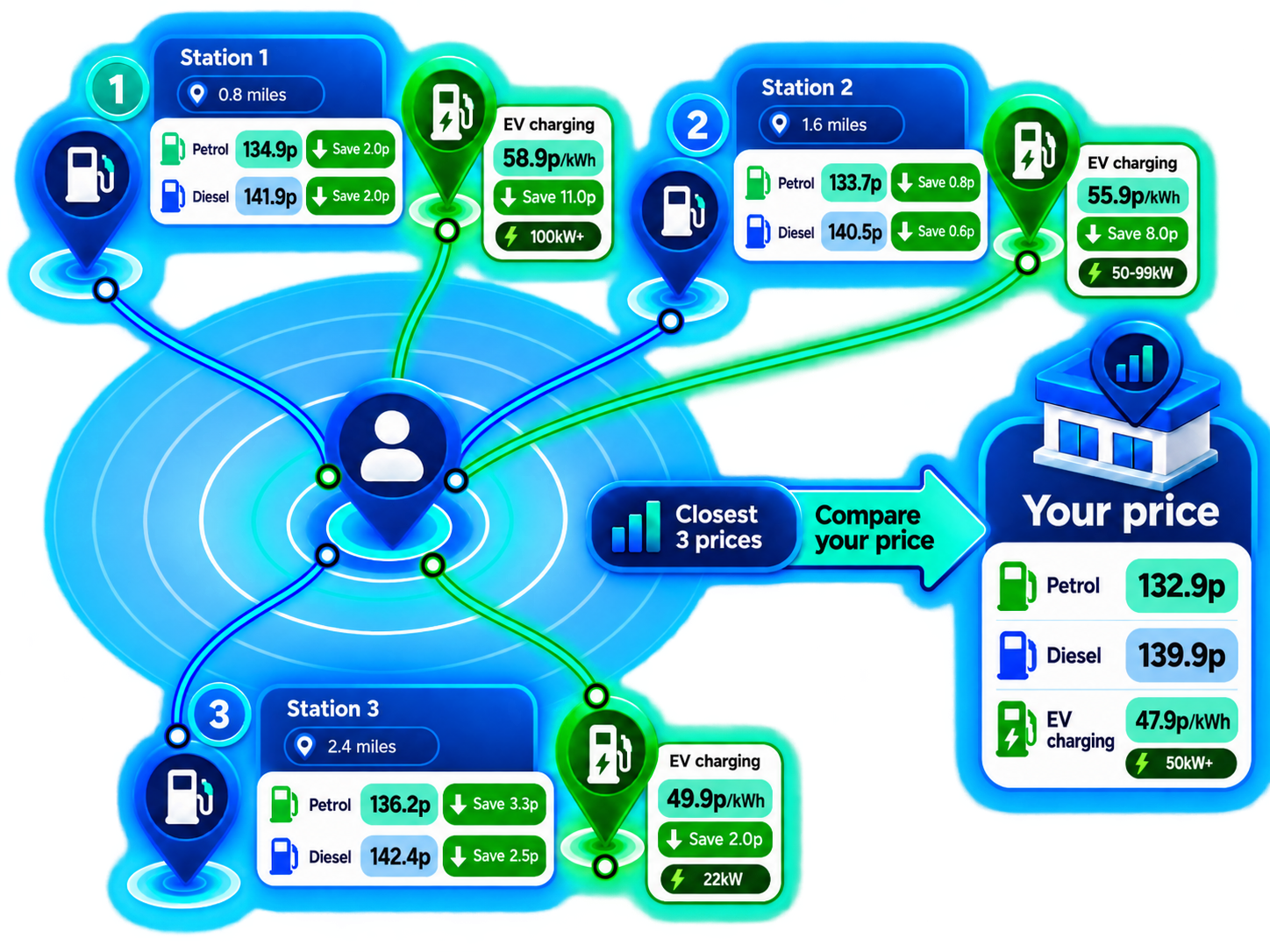
Upload a spreadsheet of names and postcodes. We match every one against the national list of UK forecourts and public charge points, then hand it back with the three closest of each, the network behind them, the distance, today’s price for every fuel grade and every power band, and exactly how far above or below them you are priced.
See it on one of your own postcodes
Five checks a day per visitor. These are the real numbers, from the same data a paid job uses.
What you get back
One row per contact. Pence per litre and pence per kWh, side by side. The closest sites, how far away each one is, what each is charging today, and whether you are above or below them on every grade and every power band you sell.
Forecourts held
8,042
The national list, refreshed twice a day
Postcodes held
2.7m
Every UK unit postcode, live and retired
Priced per contact
6 + 3
Six fuel grades, three EV power bands
Per job
100k
Contacts in a single upload
Retention
14 days
Then your contact data is destroyed
How it works
No API to build against, no data team required. A spreadsheet in, a spreadsheet out.
CSV or Excel, up to 100,000 rows. Point at your name and postcode columns, then tick what you want: forecourt fuel, EV charging, or both.
We count the usable records and show you exactly what the job costs before it runs. Rows we cannot use are never charged for.
A live progress bar that updates every few seconds. Close the tab if you like, the job carries on and we email you when it is done.
One row per contact: your columns, then three forecourt blocks and three charger blocks, each with the network, the distance and a price for every grade and power band.
A worked example
Three real rows, start to finish. Switch price comparison on, switch EV charging on, and watch the file change.
The simplest run. Name and postcode in, the three nearest forecourts and every grade they file back.
| customer_name | postcode | account_manager |
|---|---|---|
| Bramley & Sons Ltd | LS1 4AP | R. Okafor |
| Nightingale Care | BS1 5TR | R. Okafor |
| Cheriton Haulage | PL4 0DX | M. Iqbal |
Swipe the sheet sideways for the rest of the columns →
Only the name and postcode columns are required. Anything else you tick is carried straight through, untouched.
Shown for the first contact, Bramley & Sons Ltd, LS1 4AP. Every contact in the file gets the same, worked out against its own prices.
Its three nearest forecourts, every grade
| site | name | brand | miles | e5 | e10 | b7_diesel | super_diesel | b10 | hvo |
|---|---|---|---|---|---|---|---|---|---|
| station_1 | Kirkstall Road | Shell | 0.80 | 142.9 | 134.9 | 141.9 | 149.9 | ||
| station_2 | Burley Road | Esso | 1.60 | 141.7 | 133.7 | 140.5 | 148.9 | 152.9 | |
| station_3 | Armley Gyratory | Tesco | 2.40 | 143.2 | 136.2 | 142.4 |
Swipe the sheet sideways for the rest of the columns →
All three forecourts, all six grades. A blank is a blank: it means that site filed no price for that grade, and we never guess one. In the file this runs across a single row as station_1_e5, station_1_e10 and so on, three blocks of columns, and each block also carries operator, full address, town, postcode, coordinates and the timestamp every price was filed with.
EV charging
Tick one box and every contact also comes back with the three nearest public charge points, what they charge per kWh today, and where your own card rate sits against them.
AC up to 22kW, rapid 50 to 99kW, ultra-rapid 100kW and above. Compare one band or all three, in the same run as your fuel.
Charge point operators are required by law to publish their live prices as open data. We read it at source, in the format they are obliged to publish it in.
Never a blank cell. If the closest rapid charger is forty miles away, that is what the row says, flagged as beyond your preferred distance. A blank would read as no competition, and that would be a lie.
Each rate carries how we know it: live from that site, that operator’s median for the band, or the published national benchmark. Filter on confidence rather than guess at it.
Price comparison
If your file carries your own pump price or your own kWh rate, point at that column. For every contact we then work out, in pence, how you sit against each of the three nearest sites, against the cheapest of them, and against their average.
E5, E10, B7 diesel, super diesel, B10 and HVO. AC, rapid and ultra-rapid. Compare one, compare all nine, same run.
164.9 or 1.649, 0.79 or 79. Either works. We normalise both sides before comparing, so differences always come back in pence, per litre or per kWh.
A positive number means you are the dearer one. Negative means you undercut them. EV rates are compared against ad hoc contactless pricing, which is what a driver pays turning up without a card.
Per grade and per band you also get the cheapest of the three, which site that was, their average, and your gap to the cheapest.
Where the data comes from
We pass on what is published and tell you when it was filed. We do not invent a price.
The government’s statutory open data scheme, which UK forecourts report to and must update within 30 minutes of any price change. We pull the national list twice a day and keep the timestamp each price was filed with.
Under the Public Charge Point Regulations 2023 every operator must publish location, availability and pricing as open data, free of charge, in a common machine-readable format. We read those feeds directly and keep the timestamp on every tariff.
2.7 million UK postcodes with coordinates, published quarterly by the ONS under the Open Government Licence. Retired postcodes are matched and flagged, not dropped.
Measured from the postcode centroid, with the exact distance in every row so you can see how close the calls were. We do not pretend it is a drive time.
Charge point coverage grows as operators publish. Where we do not hold a live tariff for a site we fall back to that operator’s rate for the band, then to the national benchmark, and the row always says which.
Rows with no usable postcode come back flagged and cost you nothing. If a postcode looks right but does not exist, it comes off the bill when the job finishes.
There is no open sign up. Tell us who you are and we will authorise your company’s email domain and agree a rate. After that anyone on that domain signs in with a code emailed to them, and their jobs are billed to their department.
Request access